

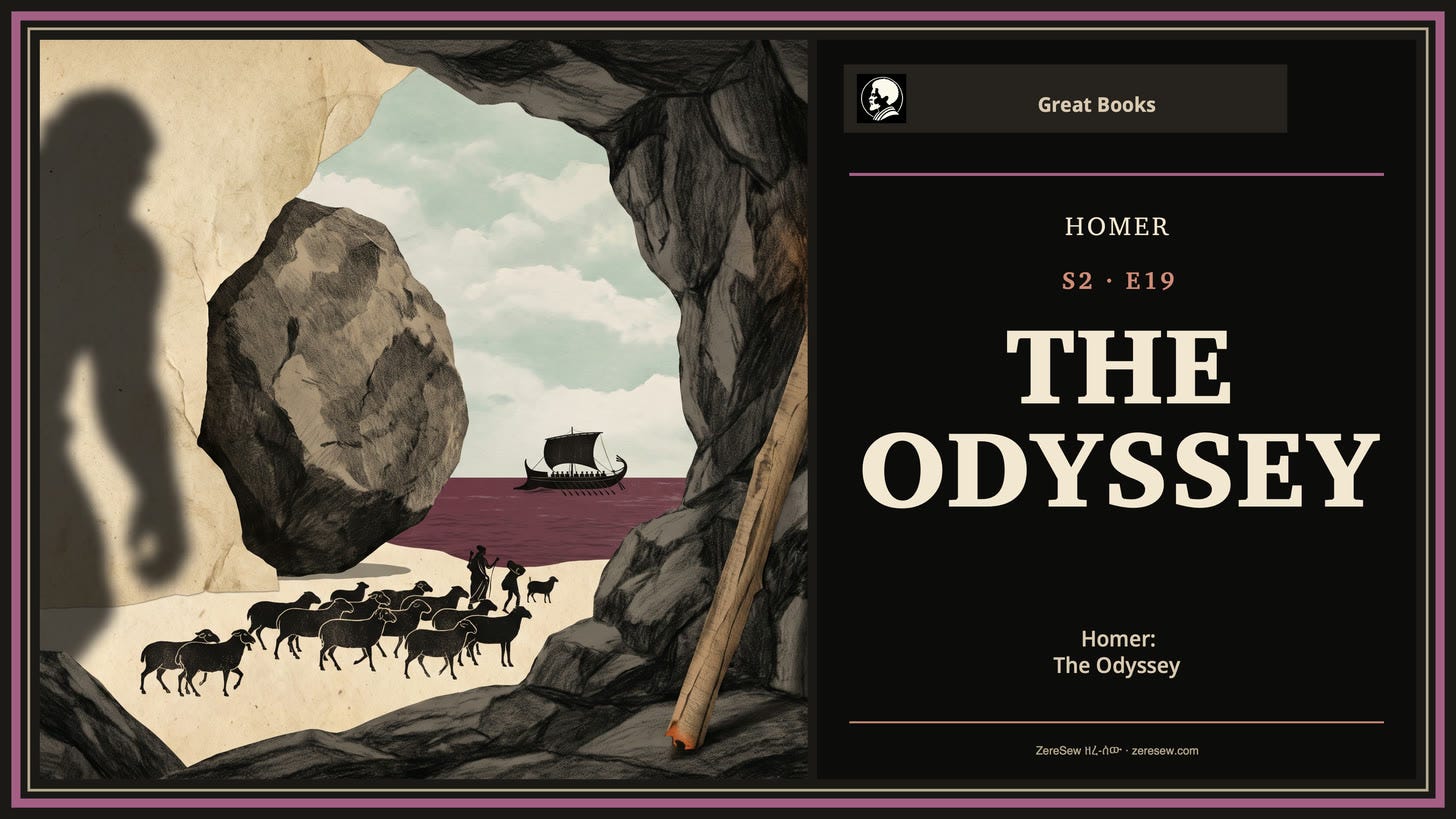
A captain and his sailors are trapped in a giant’s cave. A single slab of rock blocks the entrance, and the giant has been eating the men two at a time. The captain offers him wine, and when the giant asks his name, he says it is Nobody. The poem behind that scene runs to more than 12,000 lines, composed by a poet we can barely name, in a Greece that had only just learned to write again. This episode asks who made it, how anyone could make a poem that long without writing it down, and what world was listening. Then it tells the whole story in Homer’s order: a house full of strangers eating someone else’s food, a man who says no to a goddess, and a king who comes home to his own hall dressed as a beggar. It ends in arguments that have never been settled. Is this hero admirable, or a liar of real skill? Is the poem an old man’s advice to stay home? And when his wife finally tests him, does she already know who he is?
Part 1 — A Man Who Said His Name Was Nobody (Saba)
The cave — Odysseus and twelve of his sailors walk into the cave of Polyphemus, a Cyclops, hoping for the old rule of a meal and a gift for strangers. The giant says the Cyclopes care nothing for Zeus and eats the men two at a time. The captain cannot kill him, because if Polyphemus dies, nobody can roll the stone away. So the giant has to live and only stop seeing.
Nobody — The giant drinks three bowls of strong wine and asks: “What is your name, stranger? Tell me, and I will give you a guest-gift.” The answer is Nobody, and the gift is to be eaten last. The men drive a stake of green olive wood into his single eye. When his neighbours call through the stone, Polyphemus screams: “Nobody is killing me, friends! Nobody, by trickery!” The neighbours go home to bed.
The pun — The Greek words the neighbours use for “nobody”, “may tis”, run together into “metis”: cunning, the quality Odysseus is famous for. The poet does not point it out. He just lets Odysseus laugh.
A poet without a life — The ancient world agreed only that Homer composed the Iliad and the Odyssey. The blind Homer seems to come from a hymn once credited to him, whose singer is “a blind man who lives on rocky Chios”. Seven cities claimed his birthplace. Herodotus put him in the ninth century BC; modern scholars mostly place the poems in the late eighth or early seventh, the Odyssey after the Iliad.
The poem of old age — The critic known as Longinus said Homer made the Iliad in the full heat of his genius and the Odyssey in old age, like the setting sun, as large as ever but without the burning heat. Longinus had no information about Homer’s age at all. But Saba hears what he heard: a man who has seen everything a war can do and wants only to get home and find some peace and quiet. William Gladstone, who led four British governments, believed that by studying the two poems one could develop the entire moral code needed to live a good and just life.
Singing without writing — A little over 12,000 lines in 24 books, all in one six-beat metre, full of phrases that come back word for word: “rosy-fingered” Dawn, the “wine-dark” sea. In the late 1920s Milman Parry showed that these formulas form a system for composing aloud, at speed. In what was then Yugoslavia he found Avdo Medjedovich, a former butcher from Montenegro who had never learned to read. In July 1935, over about a week, Avdo dictated a song of more than 12,300 lines and said he knew longer ones. That does not prove one man made the Odyssey we have. It shows one man could have.
From Troy to home — The Iliad’s first word is “menin”, rage, and it ends before Troy falls. The Odyssey’s is “andra”, a man, a man “polytropos”, of many turns: driven this way and that, or turning things himself. The poem does not say which.
A reluctant soldier — Agamemnon’s ghost remembers that it took a whole month to win Odysseus over to the war. A later story, told outside Homer, has him feigning madness until Palamedes sets his baby son in front of the plough. Ten years at war, then ten more getting home, because the gods turned against the Greeks on the way back.
Part 2 — A World Without a State (Ibsa)
Two worlds — The Odyssey is set in one age and was sung in another, perhaps four or five centuries later.
The palace that burned — In the poem, Pylos is the home of old King Nestor. In 1939 Carl Blegen began digging there and on the first day found a palace archive of clay tablets, baked hard by a fire around 1180 BC. In 1952 Michael Ventris showed that their script, Linear B, was an early form of Greek. The tablets are inventories: rations, bronze for smiths, offerings to gods. A world run by clerks.
The collapse — Around 1200 BC palace after palace across the eastern Mediterranean fell. In Greece, for roughly 400 years, nobody seems to have written anything down. What survived was song. The poem remembers that a king lived at Pylos, but not the clerks.
The Greece that listened — The listeners lived in the late eighth and early seventh centuries BC. The Greeks had borrowed the Phoenician alphabet and added vowels, and were sailing west to southern Italy and Sicily. On Ischia, a cup from around 730 BC carries a joke about the cup of Nestor in Homer’s metre. And when Odysseus looks at an empty, fertile island off the Cyclopes’ coast, Ibsa hears “a settler looking at real estate.”
The open door — On Ithaca there has been no assembly for twenty years: no king, no council, no court, no police. What holds the world together is xenia, guest-friendship. You bring the stranger in, wash and feed him, and only then ask his name; when he leaves, you give him a gift. Anyone might be the stranger next month, Zeus protects strangers, and a ragged traveller might be a god. Xenia can fail from the guest’s side too, and almost every scene in the poem tests it.
The gods — The poem opens with Zeus complaining that mortals blame the gods for their own recklessness. Athena, who loves Odysseus because he is like her, wants him released. Poseidon is in the way, because Polyphemus is his son. And the gods are not tidy: Zeus lets Poseidon punish the Phaeacians, who carried Odysseus home and kept every rule of xenia. The poem does not explain why.
The singer in the hall — Demodocus, the Phaeacians’ singer, is blind; the Muse took his eyes and gave him sweet song, which may be where the blind Homer came from. For four books Odysseus himself becomes the singer, telling his adventures after dinner to hosts whose ship he needs.
Part 3 — From the Empty Chair to the Orchard (Abeba)
Abeba tells the poem in Homer’s order, from the suitors in the hall to the pact in its last line.
Ithaca Without Him
The house — Dozens of young nobles have been eating in Odysseus’ hall for years, waiting for his wife, Penelope, to choose one of them. His son, Telemachus, was a baby when he left twenty years ago.
The son — Athena, disguised as an old friend of the family, tells Telemachus his father is alive. At the assembly Antinous, the boldest suitor, tells how Penelope wove a shroud for Laertes by day and unpicked it by night for three years. At Sparta, Menelaus says Odysseus is held by the nymph Calypso. Antinous sets an ambush to kill Telemachus.
The Last Shore
Calypso — After seven years of weeping on her shore, Odysseus is released on Zeus’ order. Calypso offers immortality one last time. He answers that Penelope is less than her in beauty, and that he still wants, every day, to go home.
The Phaeacians — Poseidon wrecks his raft, and he crawls ashore on Scheria. Nausicaa sends him to the palace, and King Alcinous feeds him without asking his name. When Demodocus sings of the wooden horse, Odysseus weeps like a woman over her husband’s body, and Alcinous at last asks who he is.
The Tale at the Table
Every event here is Odysseus’ own account.
From Troy to the cave — “I am Odysseus, son of Laertes,” he begins. Twelve ships; the Cicones; the Lotus-Eaters. Out of the cave, tied under the rams, he shouts his real name at Polyphemus, who prays to his father that Odysseus come home late, alone, on a stranger’s ship, to trouble in his house. The sea god hears him.
Winds, giants and a witch — Within sight of Ithaca he falls asleep and his crew open Aeolus’ bag of winds. The Laestrygonians destroy eleven ships. Circe turns half the crew into pigs, but the herb moly protects him, and they stay a year.
The dead — Tiresias tells him to spare the cattle of the Sun, then to walk inland with an oar until someone calls it a winnowing fan, and death will come to him “from the sea”. His mother, Anticleia, died of missing him. Agamemnon warns him to come home in secret. Achilles would rather be a poor man’s hired labourer than king of all the dead.
The cattle of the Sun — Past the Sirens and Scylla, the starving crew kill the Sun’s cattle while he sleeps. Zeus destroys the ship, and Odysseus alone drifts to Calypso’s island. The hall sits spellbound.
A Stranger in His Own House
Ithaca — Set down asleep on Ithaca, he lies at once to Athena, who smiles at him and disguises him as an old beggar. The swineherd Eumaeus feeds him, because all strangers come from Zeus. Telemachus escapes the ambush, and father and son weep like sea eagles robbed of their young. There are 108 suitors.
Argos — On a dung heap at the gate lies the old dog Odysseus raised. Argos wags his tail but cannot come to him, and dies as soon as he has seen his master again in the twentieth year.
By the fire — Antinous throws a footstool at the beggar. Odysseus warns the kindly suitor Amphinomus, who does not leave. That night the stranger describes to Penelope the brooch she fastened on Odysseus herself, and his eyes stay as steady as horn or iron while she weeps. The old nurse Eurycleia finds his scar, and he grips her throat to keep her quiet. Penelope announces the contest of the bow.
The Bow
The contest — No suitor can string it. Odysseus strings it as easily as a musician fits a lyre string, and shoots through all twelve axes.
The suitors — The first arrow goes through Antinous’ throat. Eurymachus offers repayment and is refused; Telemachus kills Amphinomus. Only the singer Phemius and the herald Medon are spared. Odysseus stops Eurycleia’s cry of triumph: it is unholy to gloat over the dead.
The twelve — Of fifty women, Eurycleia names twelve as disloyal. They are made to clean the hall, then Telemachus hangs them from a ship’s cable. The goatherd Melanthius is mutilated and killed.
The Bed
The sign — Penelope sits facing the stranger in silence, then orders the bed he built moved outside. Odysseus explodes: “Woman, who has moved my bed?” He built it around a living olive tree. She runs to him; she was always afraid some man would fool her with words. Athena holds back the night.
The Orchard
Laertes — Among the dead, Agamemnon praises faithful Penelope. Odysseus finds his father digging in his orchard, tests him with one more false story, and cannot bear the old man’s grief. He proves himself with the trees his father gave him: thirteen pear, ten apple and forty fig.
The last fight — Laertes’ spear goes through the helmet of Eupeithes, the father of Antinous. Athena shouts the fighting to a stop, Zeus’ thunderbolt lands at her feet, and Athena, as Mentor, makes a pact. That is the last line of the poem.
Three Questions (Abeba’s readings)
Is Odysseus admirable? — He endures everything and says no to immortality. But every man he led from Troy is dead, some of their own folly, some of his: he stayed in the cave hoping for a gift, then shouted the name that let the giant curse him. Abeba’s reading is that the poem admires what he can bear more than what he decides, and his crew pay for his mistakes.
Is there no such thing as lying, only getting caught? — He lies to nearly everyone, each lie tuned to its listener. But he is caught in the end by a dog, a scar, a bed and thirteen pear trees, and the one time his words cost him everything, he was telling the truth. Abeba’s reading: “The man of many turns is known, in the end, by things that do not turn.”
Glory, or home? — Kleos is glory, literally “what is heard”. One reading makes the poem an old man’s advice: stay home and be content with a simple happiness instead of glory. Achilles and Penelope’s promised song support it. But Odysseus wants both, and home does not hold him. Abeba’s reading is that the poem believes in the simple life and does not let its hero have it yet.
Part 4 — Discussion (Dawit & Tigist)
The bed that cannot be moved — Dawit: “It’s a bed you can’t move, in a poem about a man who can’t stay put.” Tigist pushes him to Abeba’s question: does Penelope already know him when she sets the test?
She knew / she was testing — Dawit thinks she suspects him from the night by the fire: the brooch, the scar and the contest all come that night. He cites Philip Harsh’s well-known 1950 article. Tigist answers that the poet credits Athena with the idea of the contest, and that Penelope alone refuses the scar after twenty years of lying travellers. They do not agree.
A complicated man — In 2017 Emily Wilson, the first woman to publish an English translation of the whole Odyssey, rendered its opening as “Tell me about a complicated man.” Dante put Ulysses in Hell among the fraudulent counsellors, but Dante could not read Greek and never read the Odyssey.
The twelve women — Wilson has pointed out that earlier translations called the women “sluts” and “whores”, while the Greek is closer to “these female ones”; she wrote “these girls”. Margaret Atwood’s The Penelopiad (2005) gives the hanged maids a chorus. Tigist holds that the poem treats this as the household being cleansed. Dawit reads the ending, a goddess stopping the next killing, as unease. Unresolved: “Then I’ll keep my discomfort, and you can keep your narrator.”
Stay home — Dawit sets Abeba’s reading against the Epic of Gilgamesh, whose hero ignores a tavern-keeper’s advice to enjoy his food and his family, and goes home with nothing. Odysseus is offered immortality by Calypso and chooses that life. But Jonathan Shay, a psychiatrist who treated Vietnam veterans, argued in Odysseus in America (2002) that Odysseus’ mistrust, lying and secrecy are recognisable in the veterans he treated. Dawit says home is where the trouble starts; Tigist says it is worth the trouble. And Tiresias’ death “from the sea” can mean out of the sea or far from it.
Things Nobody Tells You
A beating in Latin. Livius Andronicus’ Latin Odyssey became a school textbook, and Horace remembered having it drilled into him by a schoolmaster he calls “plagosus”, the flogger.
Pope’s secret. Alexander Pope made a great deal of money from his Odyssey, but two hired collaborators did twelve of its twenty-four books.
No word for blue. In 1858 William Gladstone found, as he read them, no word for blue in Homer, and concluded the Greeks’ sense of colour was undeveloped. The argument is still going.
The Telegony. In a lost epic, Telegonus, Odysseus’ son by Circe, kills his father with a spear tipped with a stingray’s spine. Death from the sea. Then Telegonus married Penelope, and Telemachus married Circe.
Keats at dawn. In October 1816 John Keats sat up all night reading George Chapman’s Homer. By ten that morning, On First Looking into Chapman’s Homer was on his friend’s breakfast table.
Closing
After the whole poem, Dawit and Tigist are back where they started. Tigist thinks Penelope was testing a stranger. Dawit thinks she knew. The poem won’t tell them. Its last line belongs to Athena, still wearing the face of Mentor, the old family friend.
Key Quotations
“Nobody is killing me, friends! Nobody, by trickery!”
— Polyphemus“Cyclops, if anyone ever asks you who put out your eye, tell him it was Odysseus, sacker of cities, son of Laertes, whose home is on Ithaca.”
— Odysseus“It is astonishing how mortals blame the gods.”
— Zeus, in the poem’s first scene“I would rather be a hired labourer working the land for some poor man than be king of all the dead.”
— Achilles, in the land of the dead“Woman, who has moved my bed?”
— Odysseus“The man of many turns is known, in the end, by things that do not turn.”
— Abeba“It’s a bed you can’t move, in a poem about a man who can’t stay put.”
— Dawit
Names and Terms
People
Homer — the name given to the poet of the Iliad and the Odyssey
Herodotus — historian; put Homer in the ninth century BC
Longinus — critic of the Roman period; the Odyssey as the poem of old age
William Gladstone — led four British governments; three-volume study of Homer (1858)
Milman Parry — American scholar who showed the formulas form a system
Avdo Medjedovich — singer from Montenegro who could not read; dictated a song of more than 12,300 lines in 1935
Carl Blegen — American archaeologist who dug at Pylos from 1939
Michael Ventris — English architect who showed in 1952 that Linear B was Greek
Philip Harsh — classicist; argued in 1950 that Penelope suspects the beggar
Emily Wilson — first woman to publish an English translation of the whole Odyssey (2017)
Dante — Italian poet who put Ulysses in Hell
Margaret Atwood — Canadian novelist; The Penelopiad (2005)
Jonathan Shay — American psychiatrist; Odysseus in America (2002)
Livius Andronicus — put the Odyssey into Latin verse
Horace — Roman poet, schooled on the Latin Odyssey
Alexander Pope — eighteenth-century English poet
John Keats and George Chapman — the young poet, and the translator of Homer he read
Characters
Odysseus — king of Ithaca, son of Laertes; “polytropos”; Ulysses in Latin
Penelope, Telemachus, Laertes, Anticleia — his wife, son, father and mother
Eurycleia — the old nurse
Eumaeus — the loyal swineherd
Melanthius — goatherd who carried armour to the suitors
Argos — Odysseus’ old hunting dog
Antinous, Eurymachus, Amphinomus — the boldest, the smoothest and the kindliest suitors
Eupeithes — father of Antinous
Phemius and Medon — the singer and the herald, spared
Nestor — old king of Pylos
Menelaus — king at Sparta
Agamemnon — commander of the Greek army, murdered by his own wife and her lover
Achilles — the greatest Greek warrior, met among the dead
Palamedes — Greek officer in a later story of Odysseus’ feigned madness
Tiresias — the blind prophet
Polyphemus — the Cyclops, son of Poseidon
Calypso — the nymph who holds Odysseus for seven years
Circe — goddess and enchantress
Nausicaa and Alcinous — daughter and king of the Phaeacians
Demodocus — the blind singer of the Phaeacians
Aeolus — keeper of the winds
Zeus, Athena, Poseidon, Hermes — the gods who drive the plot; Athena ends the poem as Mentor
Telegonus — Odysseus’ son by Circe, in the lost Telegony
Gilgamesh — the king in the much older epic from Mesopotamia
Places
Ithaca — Odysseus’ island kingdom
Pylos — Nestor’s home; site of the burnt palace and its tablets
Troy — the city of the war
Scheria — island of the Phaeacians
Chios — island of the “blind man” in the hymn
Ischia — island in the Bay of Naples where the cup of Nestor was found
Terms and Concepts
Xenia — guest-friendship; the binding rule between host and stranger
Metis — cunning
Polytropos — “of many turns”: the poem’s first adjective for its hero
Kleos — glory; literally “what is heard”
Formula — a ready-made phrase fitted to the metre
Linear B — the script of the palace tablets, an early form of Greek
Moly — the herb Hermes gives Odysseus against Circe
Winnowing fan — the flat wooden shovel an oar is mistaken for
Discussion Questions
Did she know? Penelope hears about the brooch, has the stranger’s feet washed and announces the contest, all on one night, then refuses the scar and tests him with the bed. Dawit thinks she knew; Tigist thinks she was testing a stranger. Which reading does the text support better?
Who pays? Every man Odysseus led from Troy is dead. Is he admirable, or, as Emily Wilson puts it, “a complicated man”?
Lying, or getting caught? He lies to almost everyone and is caught by a dog, a scar, a bed and a count of trees. The most costly thing he ever says is his own true name. Is there such a thing as lying, or only getting caught?
The twelve women. How much of what we feel about that scene comes from the poem, and how much from its translators?
Glory, or home? Gilgamesh refuses the tavern-keeper’s advice, and Odysseus chooses that life over immortality. Is the Odyssey an old man’s advice to stay home, or a poem about home being where the trouble starts?


