

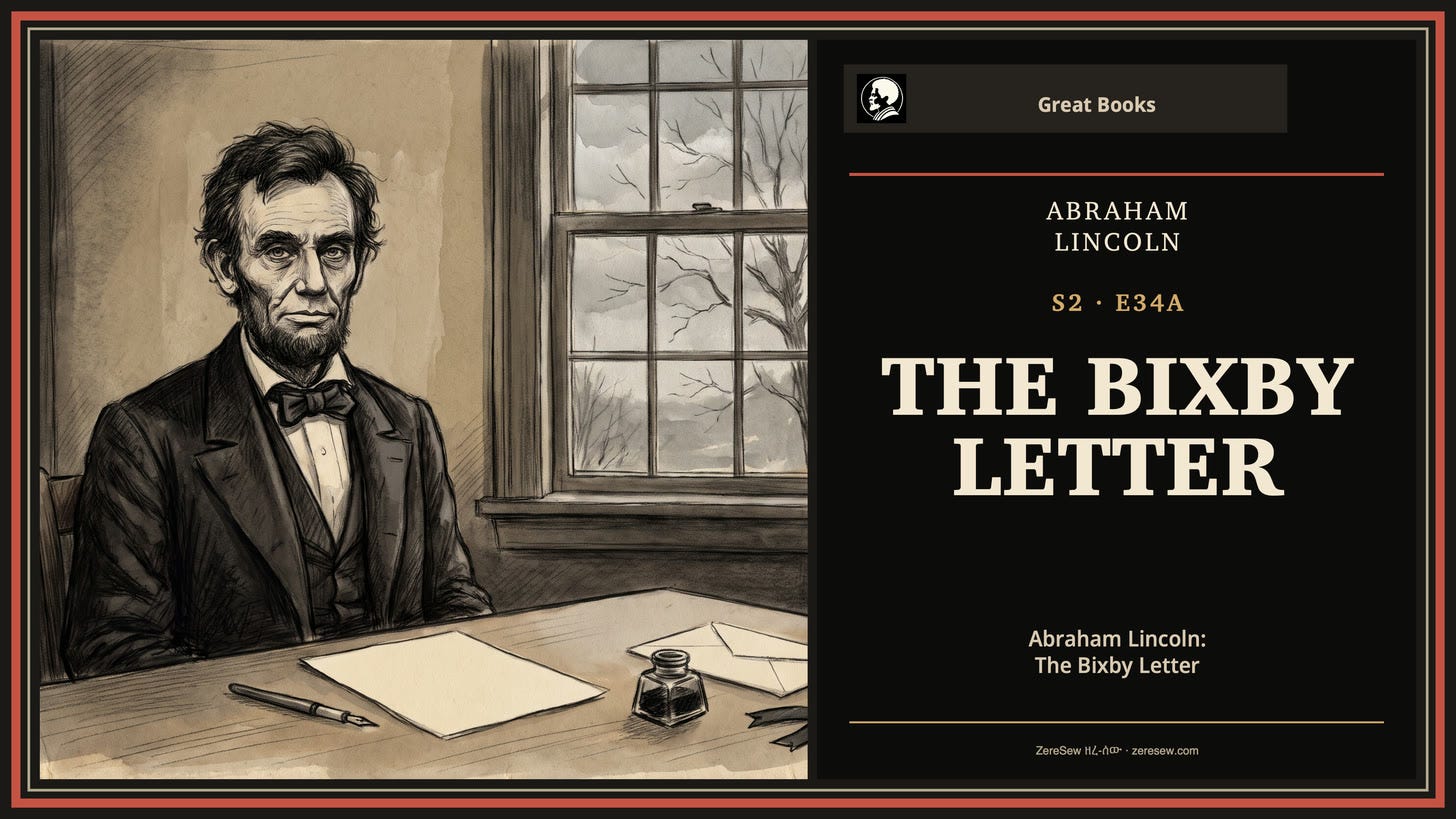
On 21 November 1864 a letter of condolence to a Boston widow went out over the signature of Abraham Lincoln, President of the United States. It is less than 140 words long: three paragraphs. It has been one of the best known of all American writings. It also has two problems. The number in it is wrong, and the original sheet of paper no longer exists. Mrs Bixby had not lost five sons in battle. Two had died in battle; one was alive at the time; one had deserted; and what became of the fifth is not known to this day. This episode follows the man the letter came from, the road a mistaken number travelled across four desks, the letter itself, word for word, and the five names behind the count. Underneath all four parts is one question: when a government writes about its dead, is it writing the truth, or is it writing consolation? And when the two don’t match, which one is left standing?
Part 1 — Show Me the Spot (Saba)
The Spot Resolutions — In the last days of 1847, with the country at war with Mexico, a newly elected congressman from Illinois put eight questions before the House. President James Polk had told Congress: “Mexico has passed the boundary of the United States, has invaded our territory and shed American blood upon the American soil.” The congressman asked whose territory that spot had been, and whether the people living there had ever submitted to American law, voted in its elections or paid its taxes. The President never answered. The document is still known as the Spot Resolutions.
What the protest was — Lincoln was not in Congress when the war was declared in 1846, so he never voted on it. He supported George Ashmun’s phrase that the war had been “unnecessarily and unconstitutionally begun by the President,” and it passed. But on every measure that gave the army its money, supplies and equipment, he voted yes. Ten years later Stephen Douglas accused him of “taking the side of the common enemy against his own country”; Lincoln answered that he had never voted to withhold anything meant for the officers and soldiers in the field.
The price — He was not popular in his own district, did not stand for a second term, and went back to Illinois to practise law.
The war — Elected President in 1860; seven states broke away before he took office; the first shot was fired at Sumter, in South Carolina, in the spring of 1861. More than 600,000 died, and some modern calculations say nearer 750,000, in a country of not much above 31 million.
A son who died in that same house — In February 1862 Lincoln’s son Willie died in the White House of typhoid fever, aged 11. Another son, Edward, had died at the age of three. Of four sons, Lincoln and his wife had buried two.
November 1864 — Lincoln was elected to a second term on 8 November. Two months earlier, in the middle of September, a Boston widow named Lydia Bixby told the Adjutant General of the state, William Schouler, that five of her sons had died in the war. On 21 November, the day the letter was written, Schouler’s Thanksgiving appeal in two Boston newspapers mentioned a poor widow who had lost five sons.
Part 2 — How the Dead Were Counted (Ibsa)
An army that did not send word — In the Civil War there was no official system for telling a family that a soldier had died. There were records. There was no notification.
Three routes home — A letter from a comrade in the regiment; the close-set columns of names in the newspapers; and silence, when a man was captured and his name dropped out of the Northern records.
Four desks — On 24 September 1864 Schouler wrote to Governor John Albion Andrew. On 1 October the War Department asked for names and regiments; six days later Schouler sent a messenger to gather them, not from the regiments’ record offices but from the mother, and on 12 October he sent his report. It reached the President some time after the end of October, by way of the Secretary of War, Edwin Stanton. At none of those stages did anyone check it. Even the War Department did not compare it with its own records.
The shape of a letter of condolence — Short, untitled, one page; sent to the family, not the dead man; written as a private letter, and not private for long, because newspapers regularly printed the President’s letters. “A letter like this is always born with two readers.”
Authorship is disputed — The White House had two young secretaries, John Nicolay and John Hay. For Hay: two newspaper clippings of the letter pasted into his scrapbook; the word beguile, found nowhere else in Lincoln’s collected writings and often in Hay’s; a whole phrase that also appears in a letter Hay wrote to a general that year; and a 2018 computer study by linguists in England. For Lincoln: in 1917 Robert Todd Lincoln wrote that Hay had told him he had no special knowledge of the letter; Hay confirmed in writing that the letter was genuine; Hay’s children never heard him claim it; a 1988 study of style by a professor of English; and the start of the same phrase, “I cannot refrain from,” in a letter Lincoln wrote before the war. “It is disputed. Nobody knows for certain.”
A leader who called the war a punishment — Around September 1862 Lincoln wrote a note for himself alone: both sides claim to be doing the will of God, and at least one must be wrong. On 4 March 1865, taking office for the second time, he spoke of the war continuing “until every drop of blood drawn with the lash, shall be paid by another drawn with the sword.”
Into print — The letter arrived at Schouler’s office on the morning of 25 November and was given to Mrs Bixby that day. That same afternoon the full text was printed in two Boston newspapers.
Part 3 — The Letter Itself (Abeba)
The greeting — “Dear Madam.” No name, and no address for her. Her name comes only at the bottom left, below the signature.
The first paragraph — “I have been shown in the files of the War Department a statement of the Adjutant General of Massachusetts, that you are the mother of five sons who have died gloriously on the field of battle.” Not a word of feeling: a filing office, an official, a statement, a number.
The second paragraph — “I feel how weak and fruitless must be any words of mine which should attempt to beguile you from the grief of a loss so overwhelming.” The country is called the Republic. It is not called America, the government or the Union.
The third paragraph — “I pray that our Heavenly Father may assuage the anguish of your bereavement, and leave you only the cherished memory of the loved and lost, and the solemn pride that must be yours, to have laid so costly a sacrifice upon the altar of Freedom.” The only religious language in the letter, and no quotation from the Bible.
The signature — “Yours, very sincerely and respectfully, A. Lincoln.”
The Five Names
| Name | Regiment | What became of him | |---|---|---| | Charles N. Bixby | Twentieth Massachusetts Infantry (sergeant) | Killed near Fredericksburg, 3 May 1863 | | Oliver Cromwell Bixby | Fifty-eighth Massachusetts Infantry (private) | Wounded at Spotsylvania, May 1864; killed near Petersburg, 30 July 1864 | | Henry Cromwell Bixby | Two Massachusetts regiments (corporal) | Captured at Gettysburg; released in an exchange of prisoners, 7 March 1864; alive on the day the letter was written; honourably discharged in December 1864; died of tuberculosis in 1871 | | Arthur Edward Bixby | First Massachusetts Heavy Artillery | Deserted from a fort in Virginia, 28 May 1862; lived through the war and returned to Boston | | George Way Bixby | Fifty-sixth Massachusetts Infantry (private) | Enlisted as George Way, apparently to hide it from his wife; captured at Petersburg, 30 July 1864; sent to the prison at Salisbury; the record contradicts itself: died in the prison, or went over to the Southern army |
Two died in battle. Schouler’s report recorded Arthur Edward as having died of wounds on an island in South Carolina, and gave the wrong regiment.
The Lost Paper
Robert Todd Lincoln looked for the original for years and did not find it. The three stories of its destruction, from 1925 and 24 years later, are late family memories, not documents from the time.
In 1891 a New York print dealer, Michael Tobin, published a picture he presented as the handwritten letter and sold it for two dollars. Every handwritten Bixby letter on a wall today descends from that print.
The picture does not match the newspapers’ text: a misspelt word, a missing word, a plural made singular, two lost capital letters, three paragraphs run into one, and an added line of address.
The handwriting expert Charles Hamilton concluded it was taken from a poor forgery, written in pencil and gone over in ink, which made Lincoln’s hand look like “a child’s scrawl.”
Three Questions
Does the wrong number break the letter? — “As a piece of writing, no. As a document, yes.” Two paragraphs count nothing; the first is nothing but a count, and it cites its own source.
Who was the letter written for? — Both recipients are in the text: the second person speaks to one woman, and the word Republic is public language.
What does the altar ask? — The letter quotes no scripture. Many readers go to John 3:16; that comparison belongs to the reader, not the letter. In the Gospel the one who gives is the father. On this page the one who gave is a mother, and the one who received is a state.
Part 4 — Discussion (Dawit & Tigist)
The root of the argument — Dawit reads the page as a speech; Tigist reads it as a document. They do not close the difference.
Tigist — “That government could write about its dead very well. What it could not do was count them.” The mistake went through four stages and nobody checked it.
Dawit — The letter opens by naming its source, the files of the War Department. That is not how a man behaves when he is hiding something. Tigist: or else he lifted the weight off himself and set it down on the files.
The stories told about Lydia Bixby — Only one thing is backed by a document from the time: in 1864 Schouler called her “the best specimen of a true-hearted Union woman I have yet seen.” The heaviest story appears forty years later, in a letter by a wealthy Boston woman, and by her own account it is something she heard.
The trap — If she says in public that her son deserted, she brands him a deserter and loses the help she is getting. If she keeps quiet, she becomes a mother she never was. And the letter was in the newspapers that same afternoon.
Why authorship matters — Dawit: it is the act of the man who signed. Tigist: then apply the same standard to the number, which went out over that same signature.
Eighty years later — In the 1998 film Saving Private Ryan, set in 1944, the letter is read before a death and becomes an order rather than a consolation. In history the Bixby letter produced no law. The five Sullivan brothers died when the Juneau was sunk on 13 November 1942, and the 1948 rule that the last surviving son of a family is not to be drafted followed from that. “So what came of it was not consolation. It was a rule.”
Things Nobody Tells You
Cromwell was their father’s name. Lydia married Cromwell Bixby, a shoemaker, in 1826 in Hopkinton, Massachusetts.
A grave with no name. Lydia Bixby died in 1878 in the Massachusetts General Hospital and was buried at Mount Hope, in Boston. The grave carries only a number, 423. Her name is in the register in the cemetery office.
The man whose desk the number left put the story into a book. After the war Schouler wrote a two-volume history of Massachusetts in the war (1868 and 1871) and set down the Bixby story himself.
John Hay. The young secretary went on to be Secretary of State, and an international treaty carries his name.
“The original.” An exhibition hall in New York took the Tobin print, stained to look old, and displayed it as the original letter.
How the five fates came to be known. Not from family memory, but from the regiments’ enlistment papers, the records of the War Department and the pension application files. The pension system demanded proof. The letter was written without any.
Closing
The difference stays open. Dawit holds to the third paragraph: write it about two sons, and it stays exactly as it is. Tigist holds to the first: it was written about five, and they were not five. No paper settles it. The original was put into one woman’s hands, and after that there is no record of anyone holding it.
Key Quotations
“It was written to one woman. It reached a country.”
— Saba (Part 1)“It is disputed. Nobody knows for certain.”
— Ibsa, on who wrote the letter (Part 2)“I have been shown in the files of the War Department a statement of the Adjutant General of Massachusetts, that you are the mother of five sons who have died gloriously on the field of battle.”
— the first paragraph of the letter“I pray that our Heavenly Father may assuage the anguish of your bereavement, and leave you only the cherished memory of the loved and lost, and the solemn pride that must be yours, to have laid so costly a sacrifice upon the altar of Freedom.”
— the third paragraph of the letter“Yours, very sincerely and respectfully, A. Lincoln.”
— the signature“As a piece of writing, no. As a document, yes.”
— Abeba (Part 3)“That government could write about its dead very well. What it could not do was count them.”
— Tigist (Part 4)“So what came of it was not consolation. It was a rule.”
— Tigist (Part 4)“The woman who was sent the best-known letter in the country’s history lies in a grave with no name on it.”
— Tigist (Part 4)
Names and Terms
People
Abraham Lincoln (1809–1865) — President of the United States during the Civil War
Lydia Bixby (died 1878) — the Boston widow the letter was sent to
Cromwell Bixby — her husband, a shoemaker
Charles, Oliver, Henry, Arthur Edward and George Way Bixby — the sons counted in the letter as five
William Schouler — Adjutant General of Massachusetts, from whose desk the number went to Washington; later wrote the state’s history in the war
John Albion Andrew — governor of Massachusetts
Edwin Stanton — Secretary of War
John Hay — one of Lincoln’s two young secretaries, said by some scholars to have written the letter; later Secretary of State
John Nicolay — the other young secretary
Robert Todd Lincoln — Lincoln’s son, who looked for the original for years
Willie Lincoln — the son who died in the White House in 1862, aged 11
Mary Todd Lincoln — Lincoln’s wife
Stephen Douglas — Lincoln’s rival in a famous election debate
James Polk — President during the war with Mexico
George Ashmun — congressman who moved the phrase “unnecessarily and unconstitutionally begun by the President”
Michael Tobin — New York print dealer who published the picture of the letter in 1891
Charles Hamilton — handwriting expert who examined that picture
The Sullivan brothers — five brothers from Waterloo, Iowa, who died on the Juneau in 1942
Places
Boston — Mrs Bixby’s city, where the letter arrived and was printed
Mount Hope — the Boston cemetery where Lydia Bixby lies in a grave with no name on it
Hopkinton — the small Massachusetts town where Lydia and Cromwell Bixby were married in 1826
Fredericksburg, Spotsylvania, Petersburg, Gettysburg — the battles in the sons’ records
Salisbury — the prison in North Carolina where George Way Bixby was sent
Washington — seat of the War Department and the White House
Terms and Concepts
Spot Resolutions — the eight questions Lincoln put before the House in 1847
Adjutant General — the officer who kept the state’s military records
Republic — a state with no king, where the ruler is chosen from among the people; the name the letter gives the country
“upon the altar of Freedom” — the letter’s last image; an altar is the place where a sacrifice is laid
beguile — to draw someone gently away from what is on their mind; a word found in Hay’s writings and nowhere else in Lincoln’s
Saving Private Ryan — the 1998 film in which the Bixby letter is read aloud
The 1948 rule — the last surviving son of a family is not to be drafted into the army
Discussion Questions
Writing or document. Abeba says the wrong number breaks the letter as a document but not as a piece of writing. Can a text be judged in two ways at once, and which judgment matters more here?
One standard. Dawit says the letter is the act of the man who signed it, whoever held the pen. Tigist says the number went out over that same signature. Does a signature carry the mistake as well as the words?
Who wrote it. The evidence for John Hay comes mostly from inside the text, and the evidence for Lincoln mostly from what people said. If a document settled it tomorrow, what would change?
No third way. Once the letter was in the newspapers, Lydia Bixby could correct it and brand her son a deserter, or keep quiet and become a mother she never was. Was that a choice?
Consolation and rule. In 1864 the page was written after the deaths. In the film it is read before one, and becomes an order. What did the country need more, the letter or the rule?


