


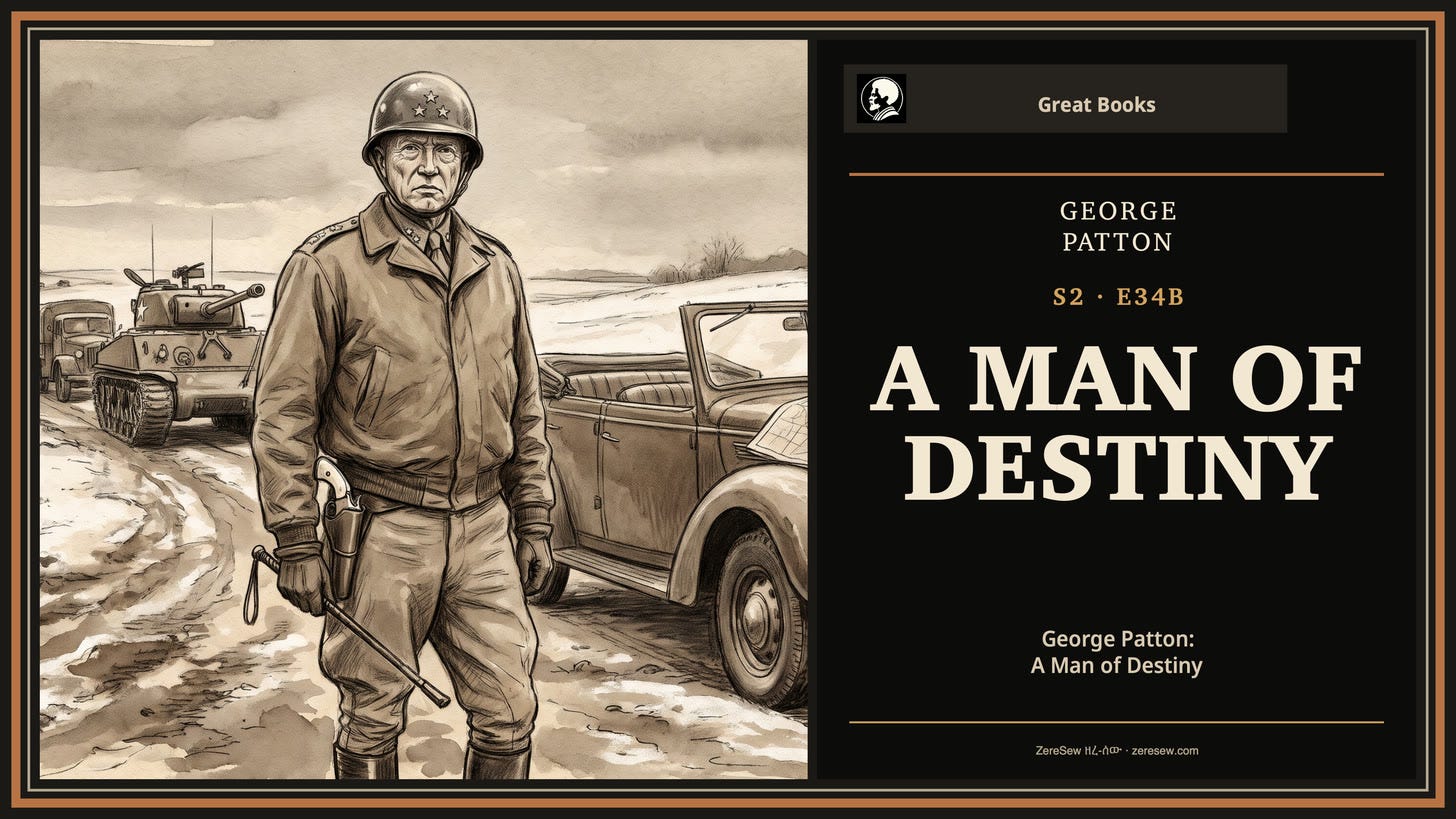
Langres, eastern France, December 1917. A thirty-two-year-old American captain arrives in a hill town he has never seen. A French liaison officer offers to show him round, and he answers: “You don’t have to,” and then, “I know it well.” He leads the way himself and names the Roman sites as he goes. His name is George S. Patton (1885–1945), and what he believed about himself was that he had fought before and died before. This episode follows the gap between that belief and the army’s record, without flattering him and without debunking him: the house he came from, the army that took to the tank, a life set out as twelve addresses, and an argument about whose work his greatest contribution was. Underneath all four parts is one question: was George Patton a man of destiny, and can what a man says about himself count as evidence?
Part 1 — The House He Came From (Saba)
Langres, December 1917 — A captain sent to set up a tank school says he knows a town he has never seen, and points out the amphitheatre, the drill ground, the forum and the spot where Julius Caesar pitched his camp. The story reaches us from Patton himself: years later he told his wife’s nephew it was “as if someone were at my ear whispering the directions.”
A correction: not his father and his uncle — The story is often told as though his father and uncle served in the Confederate army. The men who fell in the Civil War were his grandfather and his grandfather’s brother: Colonel George Smith Patton of the Twenty-second Virginia Infantry, badly wounded at Winchester on 19 September 1864 and dead six days later, and Waller Tazewell Patton of the Seventh Virginia, wounded in the jaw on the third day at Gettysburg. His father, also George Smith Patton, was born in 1856, was a small child during the war, and became a lawyer and district attorney in California.
The ancestor from the War of Independence — Hugh Mercer, born in Scotland, a doctor by profession and a general, was bayoneted at Princeton in January 1777 and died nine days later.
He could not read until he was eleven — What is now called dyslexia had no name in his day. His answer was memory: his father read aloud to him, and he kept what he heard.
Two schools — The Virginia Military Institute in 1903, for one year; then West Point, where he repeated his first year after failing mathematics. He graduated in 1909, forty-sixth in a class of 103, and went into the cavalry.
Beatrice Ayer — He married her in 1910. She was a writer herself and read everything he wrote. She comes back in Parts 2, 3 and 4.
The sword — He studied under the fencing master Cléry at the French cavalry school at Saumur, designed a straight thrusting sword for the United States Army, and became an instructor in swordsmanship at Fort Riley, Kansas, while still a second lieutenant.
Stockholm, 1912 — Fifth in the pentathlon, behind four Swedes: third in the run, fourth in the fencing, sixth in the riding, seventh in the swimming, twenty-first in the shooting. He argued that one bullet had passed through an earlier hole. The judges did not accept it.
The first shots, May 1916 — As aide to General John Pershing in Mexico, he took a small party to a ranch house in three motor cars. Three men were killed. It is cited as the first motorised attack in the history of the United States Army.
The poem — Written near the start of the 1920s. In it he says he has fought and died before, in other bodies.
Part 2 — The Army and the Paper (Ibsa)
Where the tank came from — The British sent it into battle first, on the Somme in 1916. When the United States entered the war in 1917 it had no tanks, no tank school and no manual. Patton wrote the training manual himself.
And back again — Under a law of 1920 the tank corps stopped being a branch of its own and was placed under the infantry. Patton went back to the horse.
Eisenhower — They met at Camp Meade, Maryland, in 1919. More than twenty years on, that friendship would decide Patton’s life twice.
1932: Joe Angelo — Thousands of unpaid veterans of the First World War camped on the edge of Washington, and the army cleared them out. Patton was among the officers who led the operation. Angelo, the orderly who had dragged him out of the line of fire in France fourteen years earlier, came to see him the next day. Patton’s answer: “I do not know this man. Take him away, and under no circumstances permit him to return.”
What an army is — Small units, battalion, regiment, division, corps, army. One army means men in the hundreds of thousands. Its commander is weighed on four things: strategy, tactics, command in the field, and logistics.
The French question — After France’s defeat in 1940, a government that worked with the Germans still ran Morocco. So the army the Americans met in North Africa in 1942 was French, and the commander there had to be a diplomat too.
The deception — Three methods: false radio messages, false tanks and landing craft made of wood and rubber, and false reports from German spies the British had caught and turned. The invented army group was placed in the south-east of England, opposite Calais. Patton himself was in the north-west, in Cheshire. The Germans were believed to rate him as America’s best tank commander.
How his words reached us — A diary is written on the day, but nobody checks it. War As I Knew It was published in 1947, two years after his death: his wife, Beatrice Ayer Patton, selected the material, and Paul Harkins, his deputy chief of staff, wrote the footnotes. His famous speeches have no official text. Carlo D’Este’s Patton: A Genius for War sets the diaries beside the army’s documents.
Part 3 — A Life in Twelve Addresses (Abeba)
Cheppy, France — 26 September 1918. With six soldiers and one tank he went forward against a German machine-gun position. A bullet passed through his left thigh. Joe Angelo dragged him into a shell hole, and he went on giving orders from it for about an hour.
Casablanca, Morocco — Landing on 8 November 1942 with about 33,000 soldiers and around a hundred ships. The city fell on 11 November. He signed a ceasefire with Charles Noguès, left the French administrators in their posts, and was decorated by the Sultan of Morocco.
Sicily — Landed 10 July 1943 with the Seventh Army; entered Messina on 17 August; thirty-eight days.
Nicosia, Sicily — 3 August 1943, the Fifteenth Evacuation Hospital. Private Charles Kuhl said, “I guess I can’t take it.” Patton struck him with his gloves and dragged him out by the collar. Kuhl had battle fatigue and a high fever.
Santo Stefano, Sicily — 10 August 1943, the Ninety-third Evacuation Hospital. Paul Bennett, an artilleryman, said, “I can’t stand the shelling anymore.” Patton slapped him twice and waved a pistol in his face. Colonel Donald Currier separated them. Colonel Richard Arnest’s report reached Eisenhower, who reprimanded Patton in writing but kept him. Patton apologised to both men. Drew Pearson broke the story in November 1943.
Knutsford, England — He took over the Third Army on 26 January 1944, with his headquarters at Peover Hall. On 25 April, at the opening of a welcome club, he spoke of “the evident destiny of the British and Americans, and of course, the Russians, to rule the world.” Eisenhower wrote to George Marshall on 29 April. Patton kept his job. The German Fifteenth Army stayed around Calais for weeks after the invasion.
Avranches, France — Noon on 1 August 1944: the Third Army went into action. Within two weeks it had reached Argentan.
Nancy, France — 8 December 1944. He asked his chaplain, James O’Neill, “Do you have a good prayer for weather?” O’Neill composed one of about seventy words. Patton ordered 250,000 cards. By the chaplain’s own account they reached the troops between 12 and 14 December.
Verdun, France — 9 December: Colonel Oscar Koch warned of a German counter-attack in the Ardennes. 16 December: the attack. 19 December: the commanders’ meeting, where Patton said he could turn north and attack within a few days.
Bastogne, Belgium — Three divisions turned something like ninety degrees and moved through snow. On the afternoon of 26 December a unit of the Fourth Armoured Division reached the surrounded Hundred and First Airborne.
Bad Tölz, Germany — 22 September 1945: a press conference of about fifteen minutes, and the remark about the Nazi Party and an election fight. Eisenhower removed him from the Third Army; Lucian Truscott took over on 7 October. He was moved to the Fifteenth Army at Bad Nauheim, which had no fighting troops and was writing the history of the war.
Hamm, Luxembourg — The accident was on 9 December 1945, near Mannheim; the driver, Horace Woodring, was nineteen. Two bones in Patton’s neck were broken, and nobody else was hurt. He died on 21 December 1945 at Heidelberg, and was buried on 24 December in a grave dug by German prisoners of war.
Three corrections — There were two incidents in the hospitals, not one, and Patton did not shoot anybody. The accident and the death are twelve days apart. And the prayer was not written for Bastogne: it was ordered on 8 December, and the German attack opened on 16 December.
Two questions — What does “A Man of Destiny” mean in his case? Patton did not believe he had been chosen for a task that lay ahead; he believed he had lived before. Out of that belief came both the confidence at Verdun and the pistol in the hospital tent, and nothing in his writings separates the two. And was his greatest contribution his own? While his name was pinned to the south-east of England, the German Fifteenth Army stayed at Calais. That was the work of his name, in months when he believed he was standing idle.
Part 4 — Discussion (Dawit & Tigist)
The root of the argument — Dawit reads what the name did as Patton’s victory. Tigist calls it other people’s work. They do not agree, and the difference is still open at the end.
A place still standing — Peover Hall, near Knutsford. It was built long before Patton’s time, outlasted the war, and can still be visited.
The belief, handled neutrally — That Patton believed he had lived before is on record. Whether it was true is not their argument. The prayer gets the same treatment: the dates are checked.
Eisenhower’s calculation — He did not dismiss him. He left him for eleven months with no command in battle, and in those same months pinned his name on an army group that did not exist. Tigist: what he used was not Patton’s ability but his reputation.
One man or two — Dawit: the wrong done in the hospital tent and the disowning of Joe Angelo are not one trait. Tigist: pulling them apart makes him into two men.
Where the evidence leads — Back to the man himself. Dawit: what a man says about himself is weak evidence about events, and the best evidence there is about what he believed. Tigist: “a speech that nobody wrote down is not a document. It is a memory.”
Things Nobody Tells You
Ivory, not pearl. He corrected people who said the handle of his pistol was made of pearl.
His voice. It was thin and high, and it did not fit the picture.
The sword still carries his name. He designed it in 1913. One government factory made more than 35,000, and tens of thousands more were ordered from a private company.
A medal for a prayer. The chaplain, James O’Neill, was decorated for composing the weather prayer.
The lions. The citation for the decoration from the Sultan of Morocco reads: “The lions in their dens tremble at his approach.”
Beside Napoleon. The French offered a place beside Napoleon’s tomb. His wife chose Luxembourg.
The name itself. Luxembourg comes from an old German word meaning “little fortress.”
Closing
In 1946 alone, it is said, some 200,000 people came to the cemetery in Luxembourg, most of them to see one grave. It lay in among the others, so visitors walked over the graves of other soldiers to reach it. In March 1947 the body was moved to the front of the field so that they would stop. Dawit sees the man in that picture. Tigist sees other people’s decisions. Neither has settled it, and no document settles it.
Key Quotations
“Where I fought in many guises, many names, but always me.”
— Patton’s poem“You don’t have to,” … “I know it well.”
— Langres, December 1917, as Patton told it“fought and strove and perished countless times upon this star.”
— Patton’s poem“I do not know this man. Take him away, and under no circumstances permit him to return.”
— Patton, of Joe Angelo, 1932“I can’t stand the shelling anymore.”
— Paul Bennett, 10 August 1943“The way I see it, this Nazi question is very much like a Democratic and Republican election fight.”
— Bad Tölz, 22 September 1945, as reported“my duties as undertaker at my own funeral.”
— Patton, waiting to hand over the Third Army“I know George would want to lie beside the men of his Army who have fallen.”
— Beatrice Ayer Patton“his destiny sometimes worked not through him, but through his name.”
— Abeba“The man is on one side. His name is on the other.”
— Dawit“a speech that nobody wrote down is not a document. It is a memory.”
— Tigist
Names and Terms
People
George S. Patton (1885–1945) — American general; commander of the Seventh Army and then the Third Army
Colonel George Smith Patton — his grandfather; commanded the Twenty-second Virginia Infantry; died of wounds after Winchester, 1864
Waller Tazewell Patton — his grandfather’s brother; mortally wounded at Gettysburg
Hugh Mercer — his ancestor; a general in the War of Independence; died after Princeton, 1777
Beatrice Ayer Patton — his wife; put together War As I Knew It; chose where he was buried
Dwight Eisenhower — his friend from 1919; later the supreme commander
Joe Angelo — the orderly who dragged him into a shell hole at Cheppy in 1918; disowned in Washington in 1932
John Pershing — commander of the 1916 expedition into Mexico
Charles Noguès — France’s senior administrator in Morocco
Charles Kuhl — the private struck on 3 August 1943
Paul Bennett — the artilleryman struck on 10 August 1943
Donald Currier — commander of the Ninety-third Evacuation Hospital
Richard Arnest — the army doctor who put both incidents in writing
Drew Pearson — the radio journalist who broke the story in November 1943
George Marshall — Chief of Staff of the United States Army
Oscar Koch — Patton’s chief of intelligence
James O’Neill — chaplain of the Third Army; composed the weather prayer
Lucian Truscott — the general who took over from him at Bad Tölz
Geoffrey Keyes — the general who pointed Beatrice to the cemetery at Hamm
Horace Woodring — his nineteen-year-old driver
Paul Harkins — his deputy chief of staff; wrote the footnotes to the book
Carlo D’Este — author of Patton: A Genius for War
Places
Langres — hill town in eastern France, once a Roman military camp
Cheppy — the French village where he was wounded in 1918
Casablanca — the 1942 landing in Morocco
Nicosia and Santo Stefano — the sites of the two hospitals in Sicily
Knutsford and Peover Hall — in Cheshire, in the north-west of England; headquarters of the Third Army; still standing
Calais — the French port the deception pointed to
Nancy — where the prayer card was ordered
Bastogne — the town in Belgium where the Hundred and First Airborne was surrounded
Bad Tölz and Bad Nauheim — his last two headquarters
Hamm — the American military cemetery in Luxembourg
Terms and Concepts
Tank — an armoured fighting vehicle running on tracks; first sent into battle by the British in 1916
Evacuation hospital — a temporary hospital set up behind the battlefield
Battle fatigue — what Kuhl and Bennett were suffering from
Logistics — the art of getting supplies and equipment to the right place at the right time
Division and army — a division is soldiers in the tens of thousands; an army, in the hundreds of thousands
Dyslexia — a difficulty in turning written letters back into sounds; it had no name in Patton’s day
War As I Knew It — Patton’s book, published in 1947 and put together after his death
Patton: A Genius for War — Carlo D’Este’s work of history
Discussion Questions
The man or the name. While Patton sat in Cheshire, his name was pinned to an army that did not exist, and a German army stayed at Calais. Dawit calls that his victory; Tigist calls it other people’s work. Whose was it?
What a man says about himself. Dawit says a man’s own words are weak evidence about events and the best evidence about what he believed. Tigist says that on those scales nobody ever loses. Can you judge someone by the account he left of himself?
One man or two. The confidence at Verdun and the pistol in the hospital tent came, Abeba says, from the same belief. Does that make them one trait, or two?
A speech with no paper. Patton’s most famous speeches survive only in the notes and memories of the soldiers who heard them. Is that a document, or a memory? Does the same test apply to the soldiers’ memories of the hospital tents?
The grave at the front. He was buried among his men, and moved to the front because of the crowds. Is that picture about him, or about the people who made the decisions?


